
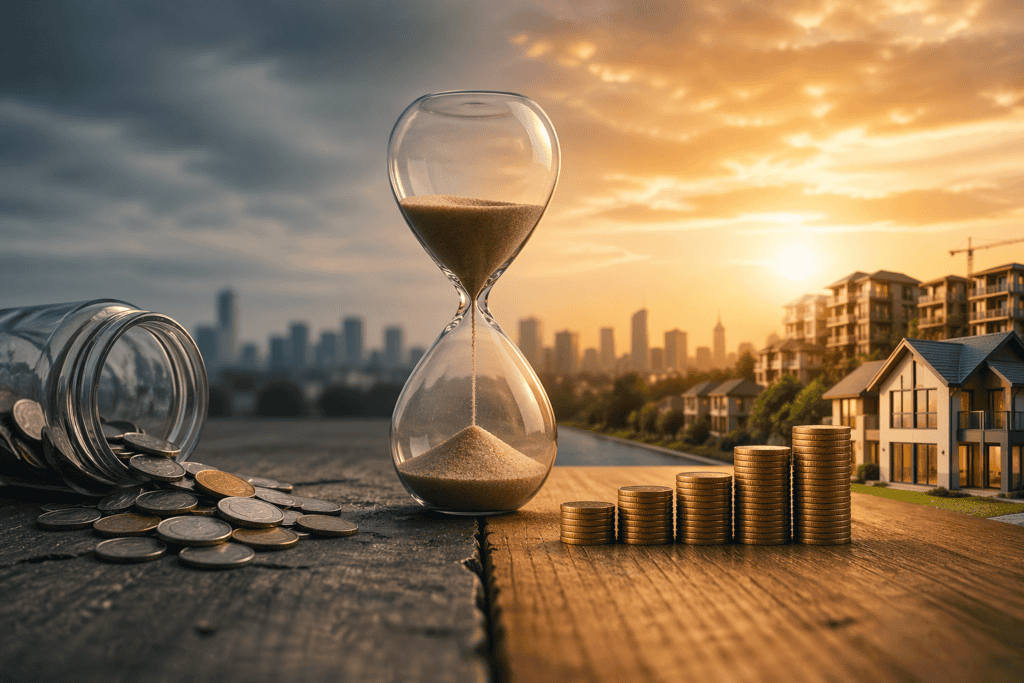
Property investment vs savings is no longer the fair fight it used to be. Most investors obsess over the risk of moving too soon. Almost none calculate the risk of moving too slowly. And yet, in a market shaped by persistent inflation, stagnant savings rates, and steadily rising property values, doing nothing has quietly become the most expensive position you can hold.
There is a comforting logic to waiting. Save a little more. Let the market “settle.” Watch one more quarter of data before making a move. On paper, it feels like prudence. In practice, it is often the single most expensive financial decision an investor makes, just one that never shows up as a bill.
The problem is that the cost of waiting does not arrive in a single statement. It accumulates in three directions at once: inflation eats your cash, savings accounts fail to keep pace, and the assets you intended to buy continue to appreciate without you on the register. Each of these is survivable in isolation. Together, they can erase years of financial progress without you ever noticing it happening.
Understanding the real cost of waiting is not about fear or urgency for its own sake. It is about looking clearly at the numbers most savers never bother to add up, because once you do, the comfortable option stops looking comfortable at all.
Inflation is the most misunderstood force in personal finance. It does not send a letter. It does not appear as a line on your bank statement. And yet it is the single most reliable mechanism by which savers quietly become poorer while feeling like they are doing everything right.
As of March 2026, UK CPI inflation stood at 3.3%, up from 3.0% in February, with the Bank of England signalling that inflation is likely to remain between 3% and 3.5% through much of 2026. Some forecasters expect it to push above 4% by the autumn as higher global energy prices feed through.
Here is what that actually means. Hold £100,000 in cash for twelve months at 3.3% inflation, and the real purchasing power of that money falls to roughly £96,800. You have not spent a penny. You have not made a single withdrawal. You are simply £3,200 poorer. Extend that over five years, and more than £15,000 of real value disappears while your balance looks untouched.
Inflation is not an abstract economic figure. It is a tax on idle cash. And unlike income tax, there is no allowance, no threshold, and no accountant in the world who can claim it back for you.
The obvious response is to assume a good savings account handles the problem. It does not.
The UK’s average instant access savings rate was 2.12% in February 2026, down from a 13-year high of 2.82% in January 2024. More revealing still, around 52% of UK savers are currently earning interest below the rate of inflation. Over half the country is actively losing money in real terms while being told they are “saving.”
“In the property investment vs savings debate, this is where cash starts to lose badly. Even the better options offer cold comfort. The average one-year fixed rate ISA pays around 3.81%. After inflation at 3.3%, the real return sits at roughly 0.5% per year. That is not wealth building. That is slow erosion dressed up as discipline.
The problem is structural, not temporary. The Bank of England base rate, currently held at 3.75%, sets the ceiling for what savings providers are willing to pay. When inflation runs close to or above that ceiling, cash cannot meaningfully grow. It can only try to tread water, and for most savers it is not even managing that.
This is the illusion at the heart of cash saving: the number on the balance never goes down, so the account feels safe. But the value of that number is shrinking every single month. Safe in nominal terms. Bleeding out in real terms. The bank statement lies to you because it can only speak in pounds, not in purchasing power.
Now look at what a well-chosen property investment has been capable of over the same timeframe.
Take St Albans, one of the most instructive examples in the UK market. In 2010, the average house price in St Albans was around £301,000. By 2020, it had grown to roughly £515,000. That is capital growth of approximately 71% over a single decade, in one well-connected commuter location, before any rental income is even counted.
Now picture two investors who started that decade with £100,000 sitting in the bank.
Investor A left the money in a typical savings account. Across ten years of low rates and accumulating inflation, the real purchasing power of that cash declined. The nominal balance may have crept up a little. The actual buying power did not. At the end of the decade, the money bought less than it did at the start.
Investor B used the same £100,000 as a deposit on a leveraged property purchase in St Albans. Because growth applies to the full value of the asset rather than the deposit, a 71% rise on a £400,000 property equals roughly £284,000 of capital gain. Add ten years of rental income on top, and the gap between the two positions is not a rounding error. It is generational.
Same starting capital. Same decade. Two entirely different lives.
Yes, the last two years in St Albans have been softer, with average prices easing to £627,000 in January 2026, down 1.8% year on year. That is exactly the point. Short-term dips are features of the property market, not exceptions to it. The long-term trajectory, driven by chronic undersupply, population growth, and the UK’s ongoing failure to hit housebuilding targets, has consistently rewarded investors who moved early and held through the noise.
There is a structural reason property has outperformed cash through inflationary periods, and it is worth understanding rather than taking on faith. Property does not sit passively while inflation eats away at it. Property fights back.
Three mechanisms are at work.
First, construction costs rise. When inflation pushes up materials, labour, and land, the replacement cost of existing buildings rises with it. In a supply-constrained market, that puts a floor under values and often a strong tailwind behind them.
Second, rents track inflation. UK rental growth has outpaced wage growth for years. As landlords’ costs climb, rents follow. For an investor holding a buy-to-let, the income stream adjusts alongside the broader economy rather than being frozen at yesterday’s price.
Third, and most powerfully, mortgage debt is inflated away. Borrow £300,000 today, and at 3% inflation each year, the real value of that debt shrinks. You are repaying tomorrow’s lender with money worth less than the money you borrowed. Cash savers experience inflation as a loss. Leveraged property investors can experience it as a structural tailwind that quietly works in their favour every year they hold.
None of this guarantees returns. But it explains, mechanically, why property has earned its reputation as an inflation hedge in a way that cash never will. Cash loses to inflation by design. Property is designed to push back.
Here is the calculation most investors never run on themselves.
If the UK property market delivers its long-run average of around 5% capital growth per year, a £400,000 property will be worth roughly £420,000 in twelve months. That is £20,000 of capital appreciation you chose not to participate in. Add gross rental income of 12% on a well-selected short-term let investment, and another £48,000 of income has walked past you. That is a potential £68,000 gap between acting now and acting in a year, on a single property. In higher-yielding developments achieving 14% gross, that gap stretches closer to £76,000.
Over two years, that gap compounds. Over five, it reshapes entire portfolios. Over ten, it defines the difference between the investor who retired early and the one still refreshing their savings account hoping for better rates.
And remember, this is before we factor in the opportunity cost of holding cash that is losing 3% per year in real terms while you wait. The investor who delays for twelve months is not standing still. They are moving backwards on two fronts at once: missing the growth they could have captured, and watching their entry capital quietly shrink. Waiting is not neutral. Waiting has a price tag, and it is rising every quarter.
None of this is to suggest that waiting is always wrong. There are genuinely good reasons to hold off: your capital position is not right yet, you do not understand the market well enough, or the specific opportunity in front of you simply does not meet your criteria. Those are legitimate reasons to pause, and anyone who tells you otherwise is selling something.
What is rarely a good reason is the vague feeling that the market might be “better” in six months, or that prices might fall a little further, or that something more attractive might come along. These are not investment strategies. They are hopes dressed up as analysis.
The most experienced investors operate on a simple principle: the right time to invest is when the fundamentals of a specific deal work, not when the broader market feels comfortable. Markets almost never feel comfortable at the bottom. By the time they do, the opportunity has already been priced in and taken by someone less cautious than you.
If you are holding significant cash reserves earning below inflation, you owe yourself two honest calculations.
The first is the real return on your current position. Take the interest rate you are earning and subtract the current CPI figure. If the number is negative, your “safe” money is not safe. It is shrinking, and it has been for a while.
The second is the opportunity cost of another year of waiting. Pick a realistic property investment you would consider, apply sensible assumptions for capital growth and rental yield, and calculate what twelve months of delay would have cost you in missed growth and missed income.
Put those two numbers side by side, and the decision stops feeling like caution. It starts looking like an expensive habit you have been quietly paying for, year after year.
There is an old line that the best time to plant a tree was twenty years ago, and the second best time is today. Property investment works the same way. The investors who built real wealth through the last decade did not time the bottom perfectly. Nobody did. They moved when the numbers made sense, and then they let time and the market do the heavy lifting while everyone else waited for a clearer signal that never arrived.
With inflation running above savings rates, cash quietly losing value every month, and the UK housing market continuing to be underpinned by structural undersupply, the cost of waiting has rarely been more visible, or more expensive. The market will not always go up in a straight line. It will not always feel easy. But the real question is not whether property is a good investment in the abstract. The real question is whether your current position is actually working for you, or quietly working against you.
Most savers never stop to ask that question. The ones who do rarely stay savers for long.
If you would like to talk through what a considered entry into UK off-plan property might look like for your situation, including the specific developments we are currently working with, we would be happy to have that conversation.


