
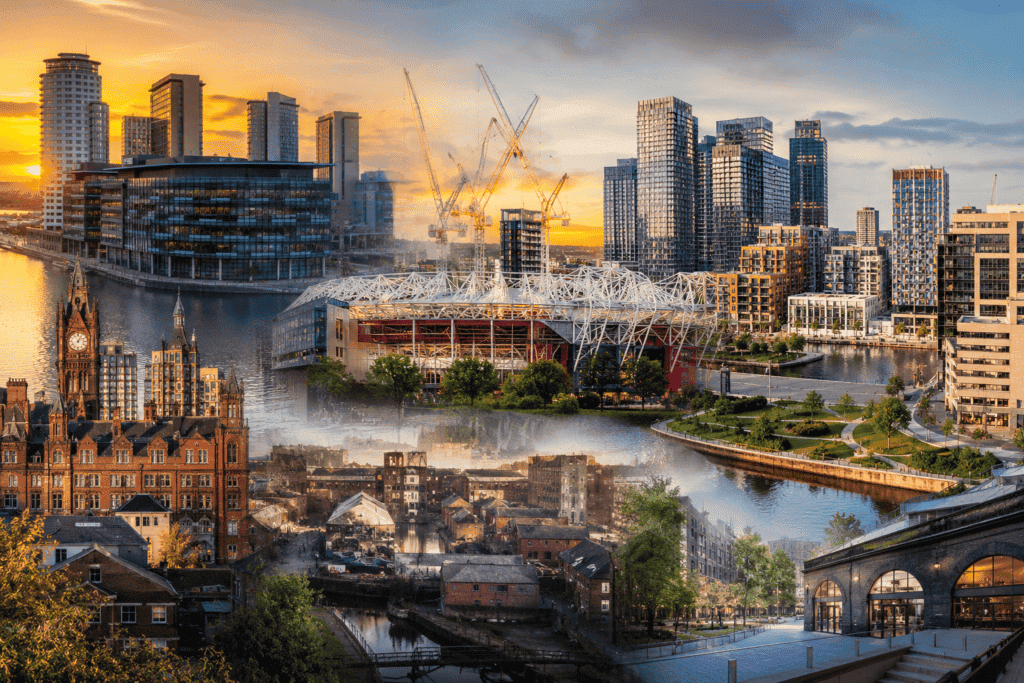
The most significant gains in regeneration zone property investment have not come from buying in already-polished postcodes. They have come from buying before the transformation happens. Here is what the evidence shows, and where the serious money is moving right now.
Ask most people how to make money from property and they will describe buying somewhere already desirable. Somewhere with good schools, good transport, good restaurants. Somewhere that already looks like an investment.
The investors who build serious wealth tend to do the opposite. They look at what a place is going to be, not what it is today. They move before the rest of the market catches up. And they buy at a price that still reflects the past rather than the future.
This is the core principle behind regeneration zone investing. It is not speculation. It is a rational, evidence-backed strategy that has produced some of the most impressive property returns in modern UK history.
The question for any investor in 2026 is simple: where are those zones right now?
Before looking at specific locations, it is worth understanding the mechanism.
When a regeneration programme is delivered at scale, four value drivers move in the same direction simultaneously: employment, amenity, infrastructure, and desirability. New employment hubs attract workers who need housing. New parks, restaurants, and cultural venues make an area more liveable. Better transport links cut journey times. And as desirability builds, rental demand rises and prices follow.
The critical point for investors is timing. By the time all of this is visible and finished, the price has already moved. The growth happens during the transformation, not after it. The window for capturing the best returns is the period when an area still looks rough at the edges but the money and the plans are already committed.
The key distinction between a strong regeneration investment and a speculative one is the level of capital already committed. Government designations, institutional backing, major infrastructure spend, and private developer activity are not promises. They are evidence. The zones covered in this article are not emerging on paper. The money is already in the ground.
If you want to understand what a regeneration story looks like from beginning to end, Canary Wharf is the place to start.
In the early 1980s, the London Docklands was one of the most derelict areas in the country. Over half of the Docklands area was derelict: the docks, factories, and warehouses that had once defined the area lay abandoned. It was polluted, economically depressed, and disconnected from the rest of the city.
The London Docklands Development Corporation was established to regenerate the area. Infrastructure investment followed. Canary Wharf became the anchor of the programme, attracting major financial institutions and triggering one of the most dramatic urban transformations the UK had ever seen.
In Canary Wharf in 2000, houses and apartments averaged £214,325. Today, Canary Wharf property prices average between £542,000 and £602,000, with prime units significantly higher. Average property prices have risen 33% since 2015 alone. The steepest growth was concentrated in the earlier phases of the transformation.
The investors who captured those returns were not the ones who waited until Canary Wharf looked like a world-class financial centre. They were the ones who bought when it still looked like a building site.
This pattern repeats, consistently, across every major regeneration programme that has followed. It is the foundation of regeneration zone property investment, and it has played out in the same way every time.
Canary Wharf happened. Trafford is happening.
The scale of what is being committed to Trafford is difficult to overstate. Trafford Council has approved Manchester United’s strategic development framework for the area, estimating that up to 48,000 jobs and 15,000 homes could be created, with an economic boost valued at more than £4 billion.
Old Trafford has been designated a Mayoral Development Area by the Greater Manchester Combined Authority, carrying the weight of governmental backing, mayoral authority, and institutional investment. Oxford Economics estimates the land around the stadium could generate more than £7 billion for the UK economy.
The centrepiece is a new 100,000-capacity stadium designed by Lord Norman Foster, intended to make Old Trafford the “Wembley of the North.” But the stadium is only one element. The surrounding district plan at Trafford Wharfside covers almost 400 acres and is led by the team behind London’s King’s Cross regeneration: walkable streets, improved waterfront access, and a new mixed-use neighbourhood. Around 15,000 homes are planned as part of the wider development.
That precedent is worth pausing on. King’s Cross was, not long ago, one of the least desirable parts of central London. It is now one of the most sought-after. The architects and urban planners who delivered that transformation are now working on Trafford.
Currently, average property prices in Old Trafford’s M16 postcode stand at £263,732. Comparable areas of Manchester that completed their regeneration earlier, including Ancoats and Salford Quays, command significantly higher values. The gap between what Trafford is priced at today and what comparable regenerated Manchester neighbourhoods look like is where the investor opportunity sits.
For investors seeking exposure to this regeneration corridor, One Trafford Edge positions investors within the Trafford Wharfside arc at a price point that still reflects the area’s current character, not its coming one.
Liverpool is arguably the most compelling combination of investment scale and entry price available to UK property investors right now.
Liverpool Waters is a regeneration scheme worth over £5.5 billion, bringing life back to the city’s historic docklands with residential, commercial, and retail development across five distinct neighbourhoods spanning 60 hectares of former dockland.
The anchor project is already delivered. Everton’s Hill Dickinson Stadium at Bramley-Moore Dock, a £750 million waterfront stadium, is now open and hosting Premier League football, surrounded by planned retail, leisure, and hospitality venues. Its economic modelling projects a £1.3 billion boost to the local economy, creating up to 15,000 jobs and attracting 1.4 million visitors annually.
Private capital is following in significant volume. Tom Morris, founder of Home Bargains, is planning a £1 billion cluster of skyscrapers near the Pier Head: 10 residential towers up to 60 storeys tall. Capital of that scale follows commercial logic, not sentiment.
And yet Liverpool’s entry price remains accessible. Liverpool’s average property price sits around £180,000, significantly below the UK average. Liverpool’s average house price rose by 7% between October 2024 and October 2025, a rate more than double the wider North West regional average of 3.1%. Property in the North West as a whole is forecast to see capital growth of 28.8% by 2028, with Liverpool’s regeneration a primary driver of that projection.
The combination of low entry, significant institutional commitment, and strong near-term growth forecasts is unusual. Most locations offer one or two of those characteristics. Liverpool currently offers all three.
For investors looking at Liverpool, Abbey Row offers access to the city’s regeneration story at a price point that reflects where Liverpool is today.
Leeds is delivering one of the most ambitious urban regeneration programmes in Europe, with significant implications for property investors positioned within it.
The Leeds South Bank project covers 253 hectares, equivalent to 350 football pitches, and aims to double the size of Leeds city centre. It is set to deliver over 8,000 homes and create more than 35,000 jobs. With £500 million of public investment and billions in private capital behind it, the project has received considerable national backing.
In September 2025, Leeds South Bank was named as one of 12 locations by the government’s New Towns Taskforce, with South Bank set to be one of three completed by 2029. That designation brings additional government resource and focus.
At the heart of the project is Aire Park, a 22-acre city centre park that is already changing the character of the surrounding area, with Phase One completed and Phase Two underway.
The data is already moving. Over the past five years, average property prices in Leeds have risen by 27.6%. LS10, directly adjacent to the South Bank transformation, has seen prices rise 48% over the same period, driven by regeneration, improved transport links, and new development. The South Bank is not finished. That growth may not yet be fully reflected in current values.
Aire Gardens places investors within the Leeds South Bank regeneration programme, at a stage where the transformation remains in progress.
Look at Canary Wharf, Trafford, Liverpool, and Leeds South Bank together and the same pattern emerges every time.
Significant public and private capital is committed. Infrastructure follows. Employment arrives. Amenity improves. Desirability builds. And property prices move, first gradually, then more sharply, before the growth is fully priced in and the window narrows.
The investors who capture the best of that growth are the ones who act during the first phase, when the area still looks like what it was rather than what it is becoming.
Timing matters, but the signal is readable. It is not about guessing. It is about identifying where substantial, credible, irreversible capital has already been committed, and positioning before the wider market fully responds.
Providence Wealth’s current portfolio places investors within active regeneration programmes, not in finished markets where the growth may already be reflected in the asking price.
One Trafford Edge sits within the £4.2 billion Trafford Wharfside regeneration, one of the most significant urban renewal projects in the country.
Aire Gardens is positioned within the Leeds South Bank transformation, a project doubling the size of one of the UK’s most economically dynamic city centres.
Abbey Row offers access to Liverpool’s regeneration story at a price point that reflects the city’s current valuation rather than its projected trajectory.
To understand how off-plan property works within a regeneration investment strategy, our Learning Hub covers the mechanics in detail. If you are ready to talk through how any of this fits your own situation, book a discovery call. The call is obligation-free and built around understanding your position before anything else.
How Off-Plan Property Investment Works
Can You Get a Mortgage on an Off-Plan Property?
Alternative Investments UK: What Every Serious Investor Should Know
What Separates a Good Property Investment Company From a Bad One
Why Waiting to Invest Could Be Your Most Expensive Decision
This article is for informational purposes only and does not constitute financial advice. Property investments carry risk. Capital is at risk and values can fall as well as rise. Past performance is not a reliable indicator of future results. Independent financial advice should be sought before making any investment decision.


