Alternative Investments UK: Property, Crypto, Whisky & More
The alternative investments UK investors ask about most often include rent to rent, HMOs, supported housing, crypto, whisky casks, fine wine, art and more. But which ones actually hold up under scrutiny?
If you have capital to deploy in 2026, you’re not short of options. Rent to rent. HMO conversions. Supported housing. Student accommodation. Property flips. Stocks. Crypto. Whisky casks. Fine wine. Art. Solar. Bonds. Savings accounts. And the timeless classic: doing nothing while inflation quietly erodes your purchasing power.
Every one of these will have someone on the internet telling you it changed their life. Several are actively promoted by people whose main income is the course about the strategy, not the strategy itself. A distinction worth keeping in mind.
This guide covers the alternative investments that come up most often in our conversations with investors. We’ve assessed what each one genuinely offers, where the risks sit, and what a sensible, well-structured portfolio might look like, with a comparison table for quick reference.
One point before we start. Diversification matters, and a well-structured portfolio shouldn’t depend entirely on a single asset class. But diversification isn’t the same as spreading capital across five things you only half understand. Quality of selection matters as much as breadth.
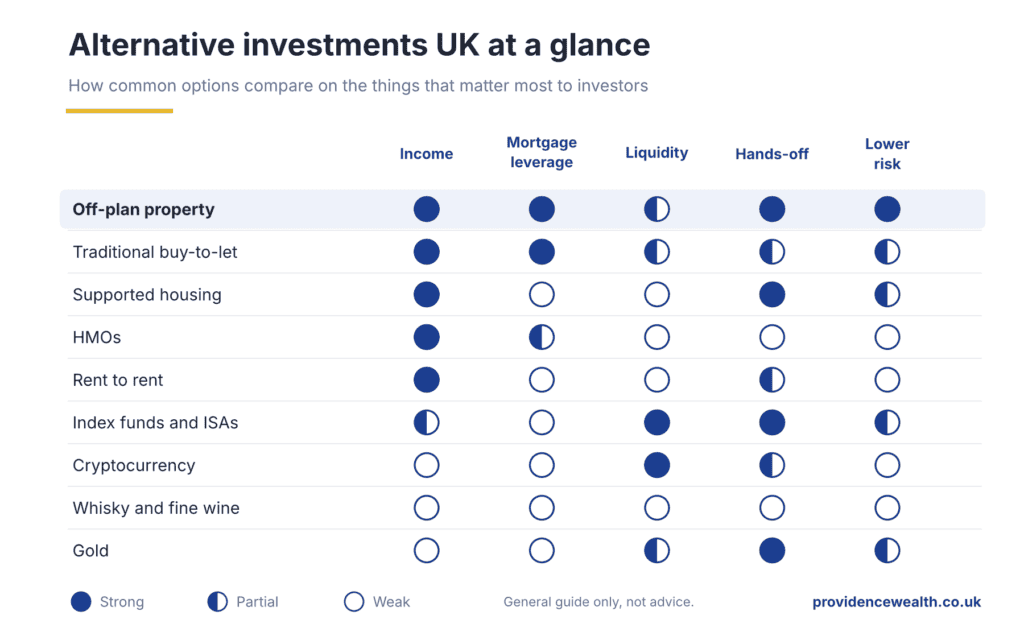
The table below covers every option in this guide, assessed against the criteria that matter most to a UK investor with meaningful capital to deploy. Risk reflects both the risk of losing capital and the risk of underperforming relative to the capital and time committed. A “very low” rating on paper doesn’t mean risk-free in practice.
Investment type
Income
Mortgage available
Liquidity
Expertise needed
Risk
Off-plan property
Yes
Yes
Medium
Low to medium
Low to medium
Traditional buy-to-let
Yes
Yes
Medium
Medium
Medium
Specialist supported housing
Yes
No (cash only)
Low
Low (fully managed)
Medium (provider dependent)
Fixed return, property-backed (restricted)
Yes
No
Low (fixed term)
Low
Medium
Property flips
No
Possible
Low
High
Medium to high
HMO conversions
Yes
Yes (complex)
Low
High
Medium to high
Purpose-built student accommodation
Yes
Rarely
Low
Medium
Medium to high
Rent to rent
Yes
No
Very low
Medium
High
Stocks and shares
Sometimes
No
High
High
Medium to high
Index funds and stocks and shares ISAs
Sometimes
No
High
Low
Medium
Cryptocurrency
No
No
High
Medium
Very high
Whisky casks
No
No
Very low
High
High
Fine wine
No
No
Very low
High
High
Solar investment
Indirect
No
Very low
Medium
Medium
Bonds (selective)
Yes
No
Medium
Medium
Low to medium
Premium Bonds
Prize draw
No
High
Low
Very low
Savings accounts
Yes (modest)
No
High
Low
Very low
Gold and precious metals
No
No
Medium
Low to medium
Medium
Art
No
No
Very low
Very high
High
Watches and collectibles
No
No
Low
High
Medium to high
One pattern stands out. Very few alternative investments score well across all five criteria. Mortgage availability matters because leverage is what turns a reasonable return into a meaningful one. Income matters because it funds your life and your next investment. Liquidity matters because circumstances change. And manageable expertise matters because most investors have jobs, families and limited hours in the day.
Off-plan residential property scores well across all five, and we’ll come back to why. Our two hands-off strategies, specialist supported housing and fixed return, trade some liquidity and leverage for fully managed income, which is why they suit a different type of investor.
Very few options score well across the board. A general guide only, not advice.
Alternative Property Investments in the UK
These are the strategies most often pitched to UK investors as an alternative to straightforward property ownership. Some work well in the right hands. Others carry caveats their advocates tend to underplay.
Traditional Buy-to-Let
Buy-to-let can still work well, but the environment has shifted. Section 24 restrictions on mortgage interest relief, stamp duty surcharges, the Renters’ Rights Act 2025 and proposals to raise minimum energy standards have made the traditional landlord model less straightforward than a decade ago. And from April 2027, landlords who own property personally will pay income tax on rental profits at 24%, 44% or 49%, following the Autumn Budget 2026 (our Andy Burnham property tax guide covers what changed).
Verdict: Still works in the right location with the right property and structure. Needs more active management and regulatory awareness than it once did.
Property Flips
Buy a run-down property, renovate it, sell at a profit. In theory, straightforward. In practice, it needs a reliable builder, a strong trade network, or the ability to manage a construction project yourself. Experienced developers with established relationships can make it work, and some have built significant businesses this way.
Without those connections, the story often goes differently. The property needs more work than the survey suggested. The contractor is delayed. Costs run over. By the time you sell, holding costs, stamp duty and capital gains tax have absorbed much of the profit. Flipping also produces no income while you hold, so everything depends on selling at the right price, at the right time.
Verdict: An active business rather than a passive investment. Best suited to those with genuine development experience. Not the right fit for investors seeking hands-off returns.
HMO Conversions
Houses in Multiple Occupation have been a staple of the property circuit for years. Multiple tenants, multiple incomes from a single asset, and on a spreadsheet the yields look compelling.
What gets less attention is the work involved. Conversions mean fire doors, interlinked detection, room size compliance and, in Article 4 areas, full planning permission before you start. Costs regularly exceed early estimates, and ongoing management means four or five tenancies rather than one, with higher turnover and wear.
The regulatory side has also become more demanding. Since December 2024, councils can introduce additional and selective licensing schemes without central government approval, fire safety upgrades can run to tens of thousands of pounds, and the Renters’ Rights Act 2025 has strengthened penalties for non-compliance. Some councils now refuse a significant share of new HMO applications.
Experienced landlords with proper systems have built substantial HMO portfolios, and the yields are real. But it demands hands-on involvement and constant regulatory attention.
Verdict: Higher yields are real, and so are the costs, complexity and regulation. Suits experienced landlords with proper infrastructure, not hands-off investors.
Specialist Supported Housing
Specialist supported housing is one of the few genuinely hands-off property strategies available, and one we offer to suitable investors. You buy a house or apartment outright within a supported housing scheme, and it’s leased to a registered housing provider on a long-term agreement. The provider places residents, manages the property and pays the rent, funded through housing benefit, with annual inflation-linked increases.
Done well, it combines strong income with no day-to-day management and a clear social purpose, helping meet a real shortage of quality supported homes across the UK.
It also has risks worth understanding properly, because not every scheme is structured well:
The provider matters most. Your income depends on the housing provider’s continued financial health. The Regulator of Social Housing has previously raised concerns about some lease-based providers, so the strength and track record of the provider is the single most important thing to assess.
It’s cash only. Mainstream mortgages generally aren’t available, so there’s no leverage.
Resale is specialist. The buyer pool is smaller than for standard residential property, so it suits investors planning to hold for the long term.
That’s exactly why we approach it the way we do. Every supported housing opportunity we offer is reviewed at director level before it reaches clients, uses registered, government-funded housing providers on 25-year leases with inflation-linked rent, and is offered only to investors for whom long-term, cash-funded income genuinely fits. Current opportunities offer net yields of up to 16%. You can find out more on our specialist supported housing investment strategy page.
Verdict: A strong option for cash investors who want long-term, fully managed income with a social purpose, provided the scheme and provider are properly vetted. Due diligence on the provider is everything.
Purpose-Built Student Accommodation (PBSA)
PBSA is often presented as a hands-off investment backed by consistent demand. There is genuine demand for quality student housing in strong university cities, and some investors have achieved reliable income through established operators.
The challenges are structural. Most PBSA is cash only, resale is usually to another PBSA investor, tenant turnover is high, and outside the strongest university cities demand can be more variable than marketing suggests. The asset’s value is tied to specific local institutions rather than the broad residential demand behind mainstream property.
Verdict: Can work in the right location with a credible operator, but it’s a specialist allocation rather than a mainstream wealth-building tool.
Rent to Rent
Rent to rent means leasing a property from a landlord and subletting it for more. The appeal is a low barrier to entry: little capital, income from day one.
But without ownership, there’s no asset, no equity and no capital growth. If the landlord ends the arrangement, a tenant defaults or repairs crop up, the pressure can build quickly, and in poorly structured deals, operators have been left with liabilities on properties they don’t own or control.
Some experienced operators have built sustainable businesses this way, and it would be unfair to dismiss the model entirely. But for investors with capital to deploy, the lack of any underlying ownership makes it hard to justify as a primary strategy.
Verdict: Low entry barrier, but no asset, no equity and limited control. The income can be real; the foundation it’s built on isn’t yours.
Alternative Investments UK: Beyond Property
A sensible investor doesn’t concentrate everything in one asset class. Each of the following has a legitimate role in a well-built portfolio. The key word, as always, is selective.
Stocks and Shares
Owning shares in well-run businesses is one of the most established ways to build wealth, and returns compound meaningfully over time. The challenge is that consistently beating the market takes deep research, significant time and a tolerance for volatility that’s easy to underestimate until you live through a real fall. The evidence consistently shows that most private investors who pick individual stocks underperform a simple index fund.
Verdict: An important part of a diversified portfolio. Approach with realistic expectations about what individual stock picking delivers.
Index Funds and Stocks and Shares ISAs
The more accessible route into equities for most people. A low-cost global index fund has historically delivered long-term returns in the region of 7% to 10% a year. You’re not beating the market; you’re participating in it efficiently and cheaply, and inside an ISA, tax-free.
Its limitation is also its strength: it’s passive and steady rather than spectacular, and it produces limited income while you build. Alongside income-producing assets, it makes excellent sense. We look at how cash and investments compare in property investment vs savings.
Verdict: Solid, low-cost, tax-efficient diversification, and a natural complement to property.
Cryptocurrency
Crypto has produced extraordinary returns for some investors and heavy losses for others, often depending on timing and position size. Volatility isn’t a side effect; it’s the defining feature. Many investors treat crypto as a speculative asset rather than a traditional investment, and that’s probably the more useful way to think about how much to hold. A small, appropriately sized position is fine, provided you’re genuinely prepared for a sharp fall in value.
Verdict: High volatility, no income, no physical asset. Fine as a small speculative allocation; not a foundation for serious wealth building.
Whisky Casks and Fine Wine
Two asset classes that share more than a shelf at an upmarket bar.
There’s a genuine secondary market for aged Scotch from well-regarded distilleries, and informed investors working with well-documented operators have seen real appreciation over multi-year holds. But the sector has also seen rising fraud and regulatory scrutiny. The Advertising Standards Authority took action against cask investment firms over misleading advertising in 2023, the City of London Police opened a fraud investigation into a cask trading company in 2024, and cases of the same cask being sold to several buyers, or casks that don’t exist at all, have been documented repeatedly.
There are structural issues too. A cask loses around 2% of its volume a year to evaporation, storage and insurance costs add up, and finding a buyer at the right price can take years. If you do invest, work only with operators who can provide bonded warehouse documentation in your name, and treat any promise of guaranteed returns with serious scepticism.
Fine wine tells a similar story. The top of the market, mainly first-growth Bordeaux and grand cru Burgundy, has a credible long-term record. Below that, the broker market has a history of selling mid-range stock at inflated prices. Provenance and storage history are everything when you sell, the market is largely unregulated, and neither wine nor whisky produces income while you hold.
Verdict: Potentially interesting for knowledgeable investors as a small allocation. Both carry illiquidity, holding costs and operator risk, and neither produces income.
Solar Investment
Solar ranges from panels on your own roof to community solar bonds and renewable energy trusts. Domestic solar can make practical sense as a way to cut energy bills, with payback periods typically of 7 to 10 years. As a vehicle for growing capital, it’s more limited: returns on solar funds and community bonds tend to sit around 6% to 8%, money is often locked in for the full term, and returns are exposed to energy prices and policy changes.
Verdict: Worth considering for diversification or an ethical allocation. Unlikely to move the needle as a primary wealth builder.
Bonds and Fixed Return Strategies
Bonds are a broad category and quality varies hugely. At the credible end, UK government gilts and investment-grade corporate bonds offer relatively predictable income and a degree of capital protection. At the other end, unregulated mini-bonds have caused serious investor losses.
For eligible investors, we also offer a fixed return property investment strategy: a structured, property-backed income arrangement with an established national developer, with a defined term and formal legal documentation. Each opportunity is reviewed at director level. It’s available only to certified high net worth and sophisticated investors, so we can only share full details, including security arrangements and risk factors, once eligibility has been confirmed. As with any fixed-income product, understand the security, the issuer and how repayment works before committing.
Verdict: A legitimate source of income when properly understood and carefully chosen. Be clear on security, issuer quality, and whether a product is regulated.
Premium Bonds
Technically a savings product rather than an investment. Premium Bonds are government-backed, with your balance entered into a monthly prize draw instead of earning interest. The effective return depends on the current prize fund rate, which NS&I reviews regularly, and your capital is fully protected. Useful for short-term cash or an emergency reserve, but not a route to building wealth.
Verdict: Good for capital preservation and cash management. Not a wealth-building tool.
Savings Accounts
A savings account is a holding place, and an important one for liquidity and emergencies. But leaving significant capital in cash long term because it feels safe has a real cost. With inflation at 3.5% in September 2026, money in an account paying less than that is losing purchasing power, just more slowly than it would under the mattress. Feeling safe and being secure aren’t the same thing. We cover this in why waiting to invest could be your most expensive decision.
Verdict: Essential for liquidity and emergencies. Not a long-term wealth strategy.
Gold and Precious Metals
Gold has historically been a store of value and a hedge in uncertain times. It produces no income; its value is simply what someone else will pay for it. As a small hedge, it has a rational place. As a growth asset, it’s a poor primary choice.
Verdict: Sensible as a small defensive allocation, not a source of income or growth.
Art, Watches and Collectibles
Art is increasingly marketed as an investment, including through fractional ownership platforms. Blue-chip works with strong auction records do have a history of long-term appreciation, but the market is opaque, driven by relationships and taste, and exposed to authentication risk. Storage, insurance and auction fees cut into returns, and fractional platforms add another layer of counterparty risk.
Luxury watches from the most sought-after brands boomed between 2020 and 2022, then corrected sharply, a reminder that even assets with strong demand aren’t immune to sentiment. Classic cars and other collectibles follow similar patterns. All of them can be enjoyable to own and can appreciate, but none produce income, and all need genuine expertise to avoid overpaying.
Verdict: A small allocation for investors with real expertise. Personally rewarding as much as financially. Not a core wealth-building strategy.
Why Off-Plan Property Stands Out Among Alternative Investments
Having worked through the alternatives, it’s worth being direct about why off-plan residential property sits at the core of so many of our investors’ portfolios. The comparison table tells most of the story, but here’s the practical case.
Mortgage leverage. Unlike almost every other option in this guide, off-plan property can be bought with a mainstream buy-to-let mortgage, typically at 75% loan-to-value. That means your capital works much harder: 10% capital growth on a property bought with a 25% deposit is a 40% return on the money you actually put in, before rental income. No whisky cask, index fund or solar bond can replicate that.
A lower entry point than you might expect. Off-plan usually needs a reservation fee and an exchange deposit of 10% to 20%, with the balance due at completion, often a year or more later. Some opportunities, such as Lakeside Residences in Nottingham, can be secured with £15,000. Our guide to how off-plan property investment works explains the full process.
Income from completion. Unlike flips, collectibles or most financial alternatives, a well-located apartment produces rent from the day the keys are handed over, which services the mortgage and compounds over time. If you’d prefer income straight away, completed options such as Chapmans Yard in Birmingham work differently.
A mainstream resale market. When you sell, you’re selling into the largest property market in the country, with owner-occupiers, landlords and investors all potential buyers, not just other specialists.
Growth during the build. Buying before completion means paying today’s price in a market that has historically appreciated over the build period, in the right locations. Our guide to the best places to invest in property in the UK covers where we see the strongest growth drivers.
Hands-off management. With a professional letting agent in place, it doesn’t need your daily involvement: far less demanding than HMOs, flips or rent to rent.
None of this means off-plan is risk-free. Values can fall, developments can be delayed, and developer due diligence matters enormously. That’s precisely why who you work with matters as much as what you invest in, as we explain in what separates a good property investment company from a bad one. You can browse the developments we’ve selected on our investment properties page.
Strong off-plan developments, such as The Forge in Liverpool often make the most well rounded investments.
The One Thing Most Alternatives Don’t Give You
There’s something that never appears in a comparison table or a projected yield, but makes an enormous difference to how any investment turns out: informed guidance from people with direct experience and a genuine stake in your success.
With most alternative investments, you’re largely on your own. You read the brochure, attend the webinar and navigate the process as best you can. When something goes wrong, there’s rarely anyone with skin in the game on your side of the table.
Our model is built differently:
We co-invest alongside our clients in the developments we present. If we wouldn’t back it ourselves, we won’t bring it to you.
Every opportunity is reviewed at director level, from off-plan developments to our supported housing and fixed return strategies, with developers and providers whose track record and financial strength we’ve assessed ourselves.
We give you the real numbers, including net yield after costs and total return, on every discovery call.
We make the process hands-off, with introductions to trusted mortgage brokers, solicitors and property managers, and limited company setup at no extra cost where it suits you.
We work with a focused number of investors at any one time, because the quality of guidance depends on the attention we give each person.
Our Managing Director, Sam Taylor, has spent well over a decade at the heart of the UK property market, including as a founding director at Purplebricks and Sales Director at Chancellors. That experience of how developments are structured, and what separates a credible developer from a problematic one, is available to every investor we work with, from the first conversation to completion and beyond.
You’re not buying a product. You’re gaining a relationship with people who understand this market, invest in it themselves, and are committed to your outcome. That’s something no whisky cask brochure or fractional art platform has ever offered.
What Does a Sensible Portfolio Look Like?
Diversification simply recognises that different assets behave differently in different conditions, and that putting everything in one place carries unnecessary risk.
For a UK investor with meaningful capital, a sensible framework might be:
A core of residential property, such as off-plan, for capital growth and rental income
A stocks and shares ISA for long-term equity exposure, with regular contributions
A cash reserve in Premium Bonds or a high-interest account for liquidity
For cash-rich investors seeking fully managed income, a hands-off allocation such as specialist supported housing
A small allocation to other alternatives you understand well, such as gold or a tangible asset
What it doesn’t look like: a collection of speculative positions in crypto, whisky, wine and unregulated bonds held in place of anything with real underlying value and income.
Build from a secure base and keep speculative assets small. Illustrative only.
Ready to Talk Through Your Options?
If you have capital to deploy and want to understand how property fits into a broader portfolio, we’d like to talk. Our discovery calls are obligation-free, straightforward, and built around understanding your situation before we discuss anything else.
Alternative Investments UK: Frequently Asked Questions
What are the best alternative investments in the UK?
It depends on your goals, but for most investors the strongest options combine income, growth and manageable risk. Residential property, including off-plan, stands out because it can be mortgaged, produces rent and sells into a large market. Index funds offer low-cost diversification alongside it, and fully managed strategies such as specialist supported housing can suit cash investors focused on income.
What are the main alternative property investments in the UK?
Common options include HMOs, rent to rent, purpose-built student accommodation, specialist supported housing and property flips. Each can work in the right hands, but most need more capital, expertise or active management than standard residential investment, so due diligence is essential.
Is specialist supported housing a good investment?
It can be, for cash investors who want long-term, fully managed income with a social purpose. Rent is paid by a registered housing provider under a long lease, usually with inflation-linked increases. The key risks are the provider’s financial strength and a smaller resale market, so the scheme and provider need to be properly vetted.
Are whisky casks and fine wine good investments?
They can appreciate, but they produce no income, are hard to sell quickly, carry storage and insurance costs, and have seen rising fraud cases. They suit knowledgeable investors as a small allocation rather than a core holding.
Is crypto an alternative investment?
Many investors treat it as a speculative asset rather than a traditional investment. It’s highly volatile and produces no income, so any allocation should be small enough that you could absorb a significant fall.
How should I diversify my investments?
A sensible approach combines a core of income-producing assets such as property, long-term equity exposure through an ISA, a cash reserve for emergencies, and only small allocations to speculative or specialist assets you understand well.
This article is for information only and does not constitute financial advice. Property and other investments carry risk; capital is at risk and values can fall as well as rise. Yields on specialist supported housing are not guaranteed and depend on the housing provider’s continued performance. Our fixed return strategy is available only to certified high net worth and sophisticated investors and is not suitable for everyone. Independent financial advice should be sought before making any investment decision. TheFCA’s guidance on investment scamsis a useful resource when assessing any alternative investment.
Market data and statistics referenced across this website are sourced from publicly available reports by ONS, Land Registry, Savills, RICS, and other recognised industry bodies. All figures are provided for indicative purposes only. Property investments carry risk. Capital is at risk and property values can fall as well as rise. Past performance is not a reliable indicator of future results. This website does not constitute financial advice. Independent financial advice should be sought before investing.
Manage Consent
To provide the best experiences, we use technologies like cookies to store and/or access device information. Consenting to these technologies will allow us to process data such as browsing behaviour or unique IDs on this site. Not consenting or withdrawing consent, may adversely affect certain features and functions.
Functional
Always active
The technical storage or access is strictly necessary for the legitimate purpose of enabling the use of a specific service explicitly requested by the subscriber or user, or for the sole purpose of carrying out the transmission of a communication over an electronic communications network.
Preferences
The technical storage or access is necessary for the legitimate purpose of storing preferences that are not requested by the subscriber or user.
Statistics
The technical storage or access that is used exclusively for statistical purposes.The technical storage or access that is used exclusively for anonymous statistical purposes. Without a subpoena, voluntary compliance on the part of your Internet Service Provider, or additional records from a third party, information stored or retrieved for this purpose alone cannot usually be used to identify you.
Marketing
The technical storage or access is required to create user profiles to send advertising, or to track the user on a website or across several websites for similar marketing purposes.
Get our full guide to off-plan investment, real numbers, our due diligence process, and what actually happens from first call to completion. Opens straight in your browser, nothing to download.