Buying Property Through a Limited Company in 2026: Is It Right for You?
Should you buy your next investment property through a limited company?
For a growing number of UK investors, the answer is yes, and the case got noticeably stronger at the last Budget. From 6 April 2027, landlords who own property in their own name will pay tax on rental profits at new, higher property income rates, while limited companies carry on paying corporation tax as before. Add Section 24’s restrictions on mortgage interest relief, and buying property through a limited company now looks very different from personal ownership on paper.
But it isn’t the right choice for everyone, and the headline tax saving isn’t the whole story. This guide covers how the structure works, what the Budget changed, a worked example with real numbers, the costs people tend to forget, and how to tell whether it suits you.
If you’re planning more than one purchase, it’s worth reading alongside our guide on how to build a property portfolio, because the right structure depends as much on where you’re heading as where you’re starting.
Why More Investors Are Buying Property Through a Limited Company
Most investors buying property through a limited company use what’s known as a Special Purpose Vehicle (SPV): a limited company set up solely to buy and hold investment property. It’s a simple structure, but it changes the tax treatment of everything that happens inside it.
Section 24: Where It Started
The shift really took hold after Section 24 of the Finance Act restricted how individual landlords claim relief on mortgage interest. Instead of deducting interest from rental income before working out their tax, personal landlords now receive a basic-rate tax credit instead. For higher-rate taxpayers with mortgaged properties, that can mean paying tax on a figure much closer to turnover than profit.
Limited companies were never subject to that restriction. A company still deducts 100% of its mortgage interest as a normal business expense before calculating what it owes.
Corporation Tax vs Income Tax
Companies pay corporation tax at 19% on profits up to £50,000, with a tapered rate up to 25% on profits above £250,000. Compare that with personal tax rates of 40% or 45% for higher and additional-rate taxpayers (rising to 42% and 47% on property income from April 2027, as we’ll come to), and it’s easy to see why the maths often works better inside a company.
It’s Now the Mainstream Route
This isn’t a fringe strategy. Companies House data shows tens of thousands of new property SPVs were incorporated during 2025 alone, and industry estimates suggest most new buy-to-let mortgage applications now come from limited companies rather than individuals. Lenders have followed: most major buy-to-let lenders now offer dedicated SPV products, which we cover in our guide to buy to let mortgage rates.
What the Budget Changed for Landlords
The biggest recent shift came from the Autumn Budget 2025, which introduced separate tax rates for property income. Those changes are now law, having been legislated in the Finance Act 2026, and they take effect from 6 April 2027.
Tax band
Rate on rental profits now
Rate from 6 April 2027
Basic rate
20%
22%
Higher rate
40%
42%
Additional rate
45%
47%
Three things matter here for anyone weighing up buying property through a limited company:
The higher rates only apply to individuals. Properties held in a limited company aren’t affected, and continue to pay corporation tax at 19% to 25%.
Mortgage interest relief for individuals moves to a 22% credit, in line with the new property basic rate. It’s still a flat credit, not a full deduction, so Section 24 continues to bite for higher-rate taxpayers. Companies still deduct interest in full.
The gap between the two structures has widened, particularly for higher-rate taxpayers with mortgages and anyone planning to reinvest profits rather than live off them.
There’s a balancing point on the company side, though. Dividend tax rates also rose from April 2026, to 10.75% for basic-rate and 35.75% for higher-rate taxpayers (the additional rate stays at 39.35%), so drawing profits out of a company now costs a little more than it did.
Individual landlords also have more admin to think about: Making Tax Digital for Income Tax began in April 2026 for people with combined property and self-employment income above £50,000, with the threshold dropping to £30,000 in 2027. Companies file through corporation tax instead.
A Worked Example: Personal Ownership vs a Limited Company
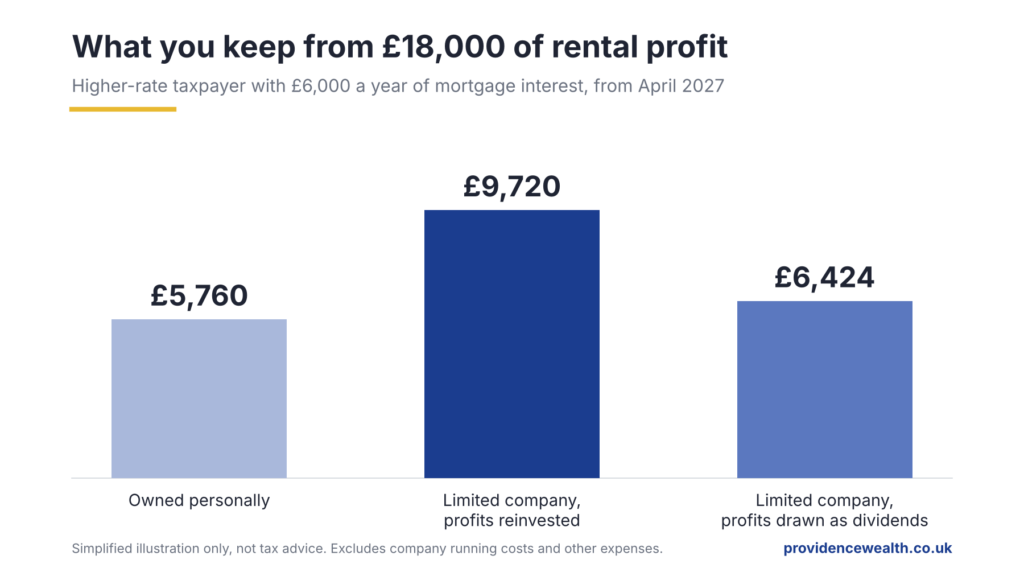
Say you’re a higher-rate taxpayer whose salary already uses up your basic-rate band. Your property makes £1,500 a month (£18,000 a year) in rental profit before mortgage interest, and £500 a month (£6,000 a year) goes on interest. Here’s how that looks from April 2027.
Owned personally
Limited company, profits reinvested
Limited company, profits drawn as dividends
Rental profit before interest
£18,000
£18,000
£18,000
Mortgage interest
£6,000
£6,000
£6,000
Tax on profits
£6,240 (42% on £18,000, less a £1,320 interest credit)
£2,280 (19% corporation tax on £12,000)
£2,280 corporation tax
Dividend tax
n/a
n/a
£3,296 (35.75% after the £500 allowance)
What you keep
£5,760
£9,720
£6,424
Two things stand out. If you’re reinvesting profits to grow a portfolio, the company keeps nearly £4,000 a year more working for you, on a single property. If you’re drawing every penny out to live on, the advantage is much smaller, and once you allow for a company’s running costs (typically around £1,000 a year for accountancy and filing), it narrows to roughly £150 a year.
That’s why limited companies make the most sense for people building a portfolio rather than buying one property for income, and why the gap widens with every property you add.
Reinvesting inside a limited company keeps nearly £4,000 a year more working for you, on a single property. Simplified illustration, not tax advice.
The Downsides of Buying Property Through a Limited Company
Buying property through a limited company isn’t a blanket win, and we’d rather you went in with your eyes open than oversell it. Here’s what to weigh up.
Mortgage rates can be a little higher. Limited company buy-to-let mortgages are often slightly more expensive than equivalent personal products, although the gap has narrowed considerably as more lenders compete for this business. Most lenders will also ask directors for a personal guarantee. If you’re buying off-plan, our guide on getting a mortgage on an off-plan property explains how the timing works.
Getting money out has its own tax bill. As the worked example shows, dividend tax can eat much of the advantage if you plan to draw all the profit out rather than reinvest it.
You lose your personal Capital Gains Tax allowance. Individuals get an annual CGT exemption when selling a personally owned property at a profit. Companies don’t, and pay corporation tax on the gain instead.
There are running costs and admin. A company needs annual accounts, a confirmation statement and a corporation tax return each year, so budget for an accountant. On a single low-profit property, these costs can outweigh the tax saving.
Stamp duty is the same, not lower. Companies pay the same 5% higher-rate surcharge on residential purchases as individuals buying an additional property. Special rules apply to higher-value properties, so take advice above £500,000.
Moving existing properties into a company is rarely simple. Transferring property you already own can trigger Stamp Duty Land Tax and Capital Gains Tax, as the company is effectively buying it from you. That’s why the structure is usually best decided before you buy, not after.
Who Does a Limited Company Suit?
There’s no universal answer, but there are clear patterns.
A limited company is more likely to suit you if…
Buying personally may suit you better if…
You’re a higher or additional-rate taxpayer
You’re a basic-rate taxpayer with modest rental profit
You’re using a mortgage, so Section 24 affects you
You’re buying with cash or very low borrowing
You plan to build a portfolio of several properties
You’re buying one property and don’t plan to add more
You want to reinvest profits rather than draw them out
You need the rental income to live on
You’re thinking about passing property on (company shares can be simpler to transfer)
You want the simplest possible setup and lowest admin
If most of your answers fall on the left, buying property through a limited company is well worth exploring. If they fall on the right, personal ownership may be the more sensible route, at least to begin with.
It’s also worth thinking about your goals beyond tax. If you’re comparing property with other ways of funding retirement, our guide to buy to let vs pension looks at how the two work together. And if you want to understand what a property will really earn after costs, whatever the structure, our explainer on gross yield vs net yield is a good place to start.
How Providence Wealth Handles This for You
This is where our clients tend to breathe a sigh of relief. If you decide a limited company structure makes sense for your investment, we arrange the company setup as part of our service, at no extra cost to you.
In practice, that means:
We handle the incorporation and Companies House registration
We make sure the company is set up correctly as a property SPV from day one, so mortgage lenders and future buyers don’t raise an eyebrow later
We work alongside your mortgage broker and solicitor so the company structure lines up with lender requirements from the outset (our guide to off-plan conveyancing explains the legal side)
We’re on hand to talk through how it fits your wider plans, in plain English, before you commit to anything
One thing we’re always upfront about: we’re property investment specialists, not accountants or tax advisers. For anything specific to your personal tax position, we’ll point you towards a qualified accountant, and we’re happy to make an introduction if you don’t already have one. What we won’t do is leave you to figure out the company setup on your own. That kind of hands-off process is exactly why clients come to us in the first place.
Providence Wealth Directors, Sam Taylor and Daniel Baxter
The Bigger Picture
Whether you buy in your own name or through a limited company, the structure is only one part of a much bigger decision. The property itself, the location, the rental yield and the growth story matter just as much. Our guide to the best places to invest in property in the UK covers where we’re seeing the strongest fundamentals right now.
If you’re planning to build a portfolio rather than buy one property and stop, it’s worth having this conversation early, not after your third purchase. You can browse what’s currently available on our investment properties page, from off-plan developments such as One Trafford Edge in Manchester to completed, income-producing options such as Chapmans Yard in Birmingham.
Frequently Asked Questions
Is buying property through a limited company worth it in 2026?
For many higher-rate taxpayers with mortgages, especially those planning several purchases and reinvesting profits, yes. The new property income tax rates from April 2027 apply to individuals, not companies, which widens the gap. For basic-rate taxpayers buying one property, the benefit is often small.
Is buying through a limited company always better?
No. It depends on your income, tax band, borrowing and long-term plans, and on whether you’ll reinvest profits or draw them out.
Do the April 2027 tax rises affect limited companies?
No. The new 22%, 42% and 47% property income rates apply to individuals who own property personally. Companies continue to pay corporation tax at 19% to 25%.
Can I get a mortgage through a limited company?
Yes. Most major buy-to-let lenders now offer products designed for property SPVs, usually with a personal guarantee from the directors.
Can I move my existing properties into a company?
Possibly, but it can trigger Stamp Duty Land Tax and Capital Gains Tax, because the company is effectively buying the property from you. Take professional advice before considering it.
Do I need a special type of limited company?
Most investors use an SPV registered with SIC codes for property letting and investment, rather than an existing trading company. Lenders generally prefer this.
Get in Touch
If you’re considering buying property through a limited company but aren’t sure it’s the right move, we’d be happy to talk it through. We can explain how the structure works, arrange the SPV setup where appropriate, and show you investment opportunities that fit your goals, all without obligation.
Tax rates and rules referenced in this article are correct as of November 2026 and apply to England, Wales and Northern Ireland; Scotland may differ. The worked example is a simplified illustration and does not constitute tax, legal or financial advice. Providence Wealth is not a tax adviser. Always seek advice from a qualified accountant or tax adviser about your personal circumstances. Property investments carry risk. Capital is at risk and property values can fall as well as rise.
Market data and statistics referenced across this website are sourced from publicly available reports by ONS, Land Registry, Savills, RICS, and other recognised industry bodies. All figures are provided for indicative purposes only. Property investments carry risk. Capital is at risk and property values can fall as well as rise. Past performance is not a reliable indicator of future results. This website does not constitute financial advice. Independent financial advice should be sought before investing.
Manage Consent
To provide the best experiences, we use technologies like cookies to store and/or access device information. Consenting to these technologies will allow us to process data such as browsing behaviour or unique IDs on this site. Not consenting or withdrawing consent, may adversely affect certain features and functions.
Functional
Always active
The technical storage or access is strictly necessary for the legitimate purpose of enabling the use of a specific service explicitly requested by the subscriber or user, or for the sole purpose of carrying out the transmission of a communication over an electronic communications network.
Preferences
The technical storage or access is necessary for the legitimate purpose of storing preferences that are not requested by the subscriber or user.
Statistics
The technical storage or access that is used exclusively for statistical purposes.The technical storage or access that is used exclusively for anonymous statistical purposes. Without a subpoena, voluntary compliance on the part of your Internet Service Provider, or additional records from a third party, information stored or retrieved for this purpose alone cannot usually be used to identify you.
Marketing
The technical storage or access is required to create user profiles to send advertising, or to track the user on a website or across several websites for similar marketing purposes.
Get our full guide to off-plan investment, real numbers, our due diligence process, and what actually happens from first call to completion. Opens straight in your browser, nothing to download.