Is Cheap Property a Good Investment? Here Is the Truth.
Is cheap property a good investment? For most first-time investors, the answer is no. They don’t lose money because they take too much risk. They lose it because they buy what looks cheap.
It’s a pattern we see regularly. A prospective investor has £50,000 to deploy and wants it to work hard. They find a property at £120,000, run the numbers, and convince themselves the lower price means better value. In most cases, it doesn’t. In many cases, it ends up costing them more than a higher-priced alternative would have.
Most investors don’t buy a bad property because they miscalculate. They buy it because the entry price feels comfortable.
This article isn’t an argument that cheap property never works. It’s an argument that for most passive investors, it’s the wrong product entirely.
For experienced, hands-on investors it can be. For passive investors, usually not
What does a low price leave out?
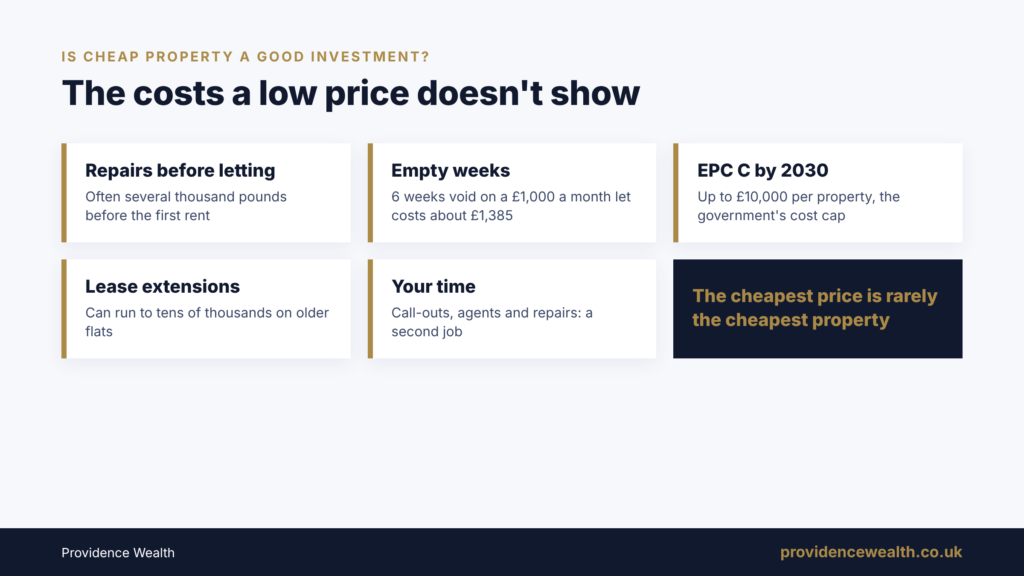
Repairs, empty weeks, EPC upgrades, lease extensions and your time
How much could EPC work cost?
Up to £10,000 per property, the government’s cost cap, to reach EPC C by 1 October 2030
What’s the passive alternative?
A modern new build or off-plan apartment in a high-demand location
How far does £50,000 go off-plan?
Often far enough to secure a city centre apartment, with the balance due on completion
Who is cheap property right for?
Refurbishers and local landlords with the time and skills to manage it
When cheap property does work
Let’s be direct about this, because ignoring it would cost us credibility.
Whether cheap property is a good investment depends entirely on the type of investor you are.
Some investors make excellent returns from lower-priced, older property. Experienced refurbishers buy below market value, add value through renovation and recycle their capital efficiently. Investors with strong local networks know specific postcodes and can source off-market deals. Active landlords manage their own properties and absorb the time cost themselves.
For those investors, a cheap property can be a very good investment.
But here’s the honest truth: most people who think they’re that investor aren’t. Managing a refurb, a letting agent, a maintenance schedule and a tenant relationship is a skill set that takes years to build. It’s also a big time commitment. It is, in every meaningful sense, a second job.
If you have the capital, the ambition and the goal of passive income, the calculation looks very different.
The purchase price is just the beginning
When investors compare a £120,000 second-hand property with a £180,000 new build apartment, they focus on the £60,000 gap. That framing is almost always misleading.
A second-hand property carries costs a new build doesn’t. Maintenance and repairs come first. Boilers, roofs, windows, electrics and plumbing in older homes fail, and they tend to fail early in your ownership, when cashflow is tightest. Before you can attract a good tenant, the property also needs to be in lettable condition. That bill alone can run to several thousand pounds before you’ve collected a single month of rent, which is why the headline yield and the real one are so often miles apart (our guide to gross yield vs net yield explains the difference).
This isn’t theoretical. It’s one of the most consistent patterns we see in investors who come to us after a disappointing first experience with older stock. The property looked cheap. The reality was expensive.
Low price often = hidden costs
The investment that becomes a second job
This is the point that doesn’t get enough attention.
Here’s what managing an older property can look like in practice: a boiler call at 7am on a Tuesday. An agent telling you the property has been empty for six weeks and they’re not sure why. A £2,000 repair bill three months after completion, before you’ve even covered your buying costs. Chasing someone to chase someone else about a tenant who’s stopped paying. That isn’t passive income. It’s a second job, and it tends to pay badly for the hours involved.
Investors who buy older properties in secondary locations often find that within 12 to 24 months, the property is taking up far more time than they expected. The gap between “passive income” and the reality of hands-on management is one of the most common frustrations we hear from investors who’ve already been there.
The people we work with are professionals, business owners and higher earners. They have capital to deploy and want it working for them, not working them.
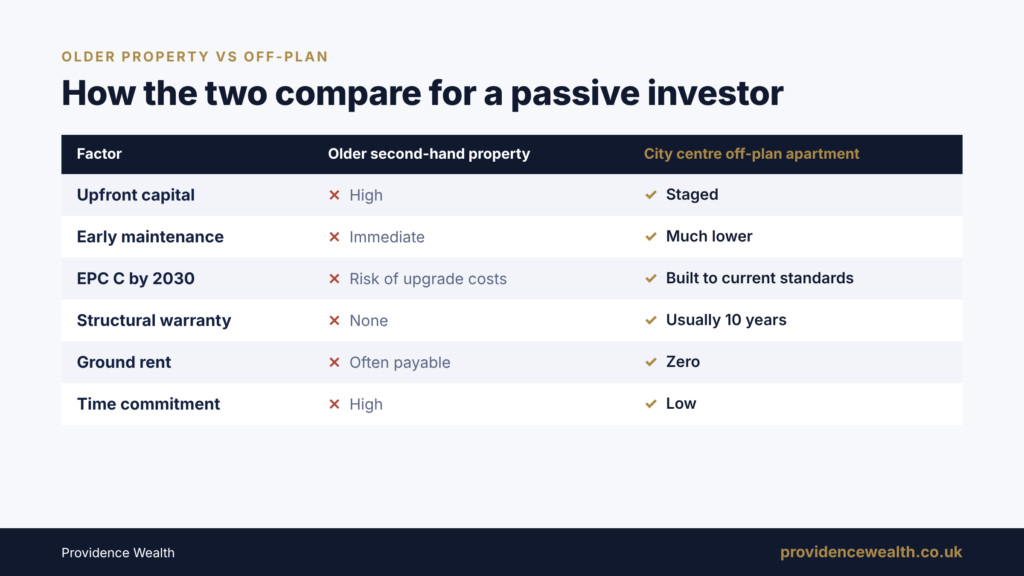
New build and off-plan investment is different here. A brand new property with a structural warranty, professional management and modern systems needs far less of your time in the early years. That’s a feature of the product, not a promise of perfection.
Leasehold, ground rent and the shrinking clock
Many second-hand flats are leasehold. The older the property, the shorter the remaining lease, and that creates two problems that build on each other.
First, mortgage lenders become more reluctant to lend on shorter leases, which shrinks your pool of buyers when you come to sell. Second, extending a lease is expensive and slow. Depending on the property and the freeholder, it can cost tens of thousands of pounds, and the process is rarely simple.
New build flats typically come with 999-year leases, which removes this risk, and many modern developments are structured as share of freehold. Under the Leasehold Reform (Ground Rent) Act 2022, new long residential leases must also have a zero ground rent. The developments we offer carry zero ground rent, which helps both your annual costs and your eventual exit. (For the other running cost to check, see our guide to service charges on new build flats.)
Resale: the problem nobody thinks about at purchase
When you buy, you’re probably not thinking about selling. You should be.
An older property that feels dated today will be even more dated by the time you want to exit. The buyer pool is narrower, your negotiating position weaker, and price growth in secondary locations has historically been more modest. You’re also competing with the entire existing housing stock when you sell.
A modern, well-specified apartment in a strong rental location appeals to both investors and owner-occupiers, and demand for that type of home keeps growing. It’s a much stronger resale position.
EPC rules: a risk investors still underestimate
Minimum energy standards for rented homes are tightening, and the direction is clear. Under the government’s minimum energy efficiency standards, privately rented homes in England and Wales must reach EPC C by 1 October 2030. Landlords may have to spend up to £10,000 per property, the government’s cost cap, to get there.
For an older property, that usually means insulation, a new heating system, glazing or ventilation. For investors who bought on a tight margin, it’s a big and often unbudgeted bill that arrives at exactly the wrong time.
New build homes are built to current energy standards and are, in most cases, well placed for the rules ahead without extra spend. If you’re buying an older property today, you may be buying a compliance problem you can’t yet price.
Tenant quality and void periods
A property’s specification directly affects the tenants it attracts. Modern apartments with good finishes, secure entry, well-kept communal areas and contemporary interiors typically attract stronger tenant demand, particularly from working professionals who pay on time, stay longer and look after the home. Voids are shorter and management is simpler. (Our guide to UK rental demand shows just how competitive the market for good rental homes is right now.)
Older properties in secondary locations tend to attract a more transient tenant base, with more turnover, more frequent voids and more hands-on management. Based on our own portfolio, the gap in net yield between a well-specified new build in a strong rental market and a dated property in a secondary location is often bigger than investors expect once voids, maintenance and management time are counted.
The 10-year structural warranty
Most new build homes come with a 10-year structural warranty, such as NHBC Buildmark, covering major defects and protecting both you and your mortgage lender. In the first two years, the developer also has to put right snags and defects (our guide to what snagging is explains how this works).
For an investor, that means two things. In the early years, you’re not exposed to structural surprises. And when you sell, the remaining warranty reassures buyers and their solicitors, which makes the sale smoother. A second-hand property offers no such protection. What you find is what you own.
The capital efficiency case for off-plan
This is where the numbers tend to shift the conversation.
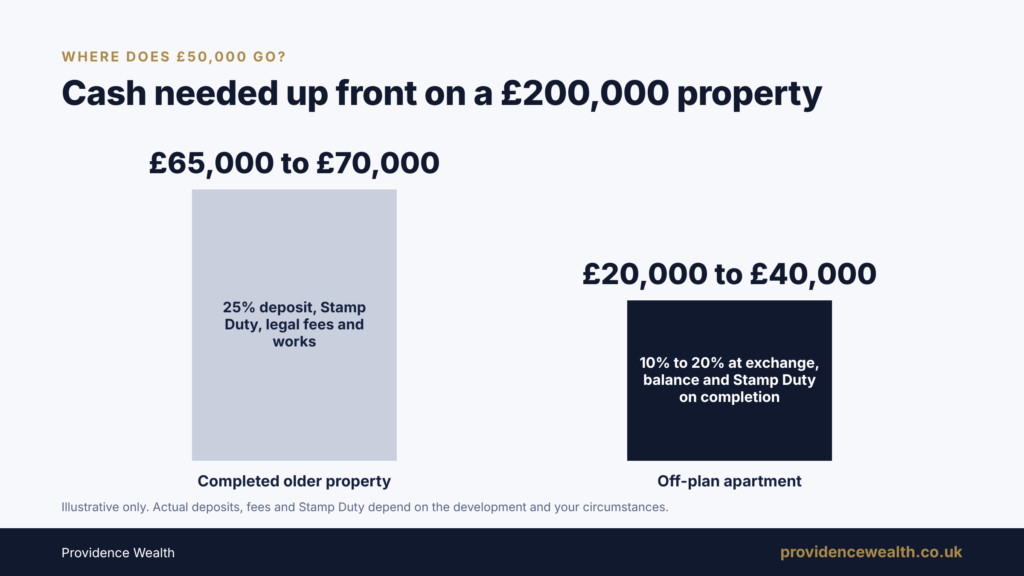
Buying a completed property means your capital lands all at once. A 25% deposit on a £200,000 property is £50,000. Add Stamp Duty, legal fees and pre-let works, and your total upfront cost can reach £65,000 to £70,000. For that, in many markets, you get an older property in a secondary location with all the risks above already baked in.
Off-plan works differently. You reserve with a small fee, then exchange contracts at 10% to 20% of the price. The balance, and the Stamp Duty, are due on completion, typically one to three years later.
During that window, two things work in your favour. The property can grow in value, and you have time to arrange mortgage finance against the completed home. Growth during the build can mean the mortgage covers most of the balance, reducing the extra cash you need at completion. Valuations aren’t guaranteed, so we’ll always show you the numbers both ways.
That same £50,000 that might have bought a dated, out-of-town property can instead secure a brand new city centre apartment in a high-demand location, with far less management, minimal maintenance in the early years and a stronger long-term resale position. For example, New Spring House in Sheffield starts from £171,000, and One Trafford Edge puts you on Manchester’s doorstep. See all current opportunities.
Some investors see this as a middle path: all the quality of new build without the wait. It’s worth addressing directly, and our guide to off-plan property vs buying on the open market covers it in more depth.
A completed new build is a good product. The quality, the warranty, the EPC rating and the tenant appeal are all there. But the most powerful financial lever in off-plan investment is missing: buying at today’s price for a home that completes in one to three years.
Off-plan homes are often sold at a discount to reflect the buyer’s early commitment and the build timeline. Combined with any market growth during the build, the gap between purchase price and completion value can be substantial. Buy a completed new build and you pay today’s market value, with none of that uplift.
The capital structure is also the same as any ready property: full deposit, Stamp Duty and legal fees all up front. There’s no staging and no deferral.
A completed new build is a good investment. An off-plan apartment in the right development, at the right stage, with the right developer, is a better one.
So, is cheap property a good investment? Not by default. For investors with the skills, time and appetite for hands-on management, it can work. For most people with capital to deploy and a goal of passive, long-term returns, it’s the wrong product.
The better question isn’t “what’s the cheapest property I can buy?” It’s “where does my capital work hardest with the least friction?” For passive investors, that points consistently towards new build and off-plan property in high-demand locations. And if you’re still deciding whether to invest at all, our guide to property investment vs savings shows what leaving it in the bank really costs.
How Providence Wealth helps
If the main appeal of a property is its price, it’s worth a conversation before you commit. The numbers often look different once you count what the price leaves out.
Director-level due diligence. Before a development reaches our website, a director has checked the developer, the location, the build and the numbers.
Real numbers on a discovery call. We’ll show you realistic rents, running costs and returns for a specific apartment, side by side with what a cheaper alternative would really cost.
A hands-off service. We introduce you to trusted mortgage brokers, solicitors who know off-plan purchases, and letting and management partners.
Free limited company setup. If you’re investing through a company, we’ll help you set it up at no cost.
We’ll look at your goals, your budget and where your capital is likely to work hardest. Straightforward, no pressure, and useful whether you go ahead with us or not.
Is cheap property a good investment for beginners?
Usually not. Lower-priced older homes tend to need more repairs, more management and more of your time. They suit experienced refurbishers and local landlords better than first-time or passive investors.
What are the hidden costs of buying a cheap property to rent?
The main ones are repairs before letting, ongoing maintenance, longer void periods, EPC upgrades and lease extensions on older flats. Together, they can easily outweigh a lower purchase price.
Do older rental properties need to meet EPC C?
Yes. In England and Wales, privately rented homes need to reach EPC C by 1 October 2030. The government has set a cost cap of £10,000 per property, after which landlords can apply for an exemption.
Is a new build a better investment than an older property?
For passive investors, often yes. Most new builds come with a 10-year structural warranty, better energy ratings and stronger tenant appeal, which usually means lower running costs and less hands-on management.
How much do I need to buy an off-plan property?
Most off-plan developments ask for a reservation fee and 10% to 20% at exchange, with the balance due on completion. That’s why £50,000 can go further off-plan than on a completed purchase.
Are new build flats leasehold?
Most are, but new long leases created since June 2022 must have a zero ground rent by law. Many also come with 999-year leases or share of freehold, which removes the shrinking-lease problem older flats face.
This article is for general information only and does not constitute financial, legal, tax or investment advice. Figures are correct as of November 2026 and examples are illustrative. Property values and rental income can go down as well as up. Please take independent advice before making any investment decision.
Market data and statistics referenced across this website are sourced from publicly available reports by ONS, Land Registry, Savills, RICS, and other recognised industry bodies. All figures are provided for indicative purposes only. Property investments carry risk. Capital is at risk and property values can fall as well as rise. Past performance is not a reliable indicator of future results. This website does not constitute financial advice. Independent financial advice should be sought before investing.
Manage Consent
To provide the best experiences, we use technologies like cookies to store and/or access device information. Consenting to these technologies will allow us to process data such as browsing behaviour or unique IDs on this site. Not consenting or withdrawing consent, may adversely affect certain features and functions.
Functional
Always active
The technical storage or access is strictly necessary for the legitimate purpose of enabling the use of a specific service explicitly requested by the subscriber or user, or for the sole purpose of carrying out the transmission of a communication over an electronic communications network.
Preferences
The technical storage or access is necessary for the legitimate purpose of storing preferences that are not requested by the subscriber or user.
Statistics
The technical storage or access that is used exclusively for statistical purposes.The technical storage or access that is used exclusively for anonymous statistical purposes. Without a subpoena, voluntary compliance on the part of your Internet Service Provider, or additional records from a third party, information stored or retrieved for this purpose alone cannot usually be used to identify you.
Marketing
The technical storage or access is required to create user profiles to send advertising, or to track the user on a website or across several websites for similar marketing purposes.
Get our full guide to off-plan investment, real numbers, our due diligence process, and what actually happens from first call to completion. Opens straight in your browser, nothing to download.