What Is Snagging? A Plain-English Guide for New Build Investors
If you’re buying a new build, you’ll hear the word “snagging” sooner or later, usually from someone who sounds like they’re about to tell you bad news. So, what is snagging? It’s simply the process of spotting small unfinished or imperfect details in a brand new property (a sticky door, a paint drip, a missing bit of sealant) and getting the developer to put them right, at no cost to you.
That last part is the bit worth remembering. Snagging isn’t a sign that something has gone wrong. It’s a normal, built-in stage of buying a new home, backed by a warranty and an industry code. And for investors, it compares very favourably with buying an older property, where every dripping tap and tired boiler is your problem and your bill.
Snagging at a glance
Question
Quick answer
What is snagging?
Finding and fixing minor defects or unfinished work in a new build
A “snag” is any small defect, unfinished job or cosmetic flaw in a newly built home. Snagging is the process of finding those snags, recording them and having the developer fix them.
It’s worth keeping in perspective. A new apartment is built by dozens of different trades, often outdoors, through every kind of British weather. Even on the best-run sites, a few small things slip through. A good developer expects this, which is why a structured snagging process exists in the first place.
Most snags fall into a few familiar groups:
Type of snag
Common examples
Decoration
Paint splashes, patchy coverage, missed edges, marks on skirting boards
Doors and windows
Doors that stick or don’t latch, windows that are stiff to open, missing handles
Gaps around baths, showers and worktops, untidy silicone
Flooring and surfaces
Scratches, chips, lifting edges, cracked tiles
Plumbing and heating
Slow drains, dripping taps, radiators that don’t heat evenly
Outside and communal areas
Unfinished landscaping, scuffed corridors, signage still to go up
None of these are dramatic, and most take a tradesperson minutes rather than days. The point of asking “what is snagging?” isn’t to brace yourself for problems. It’s to know your rights so that every one of these gets fixed properly, at the developer’s expense.
When does snagging happen?
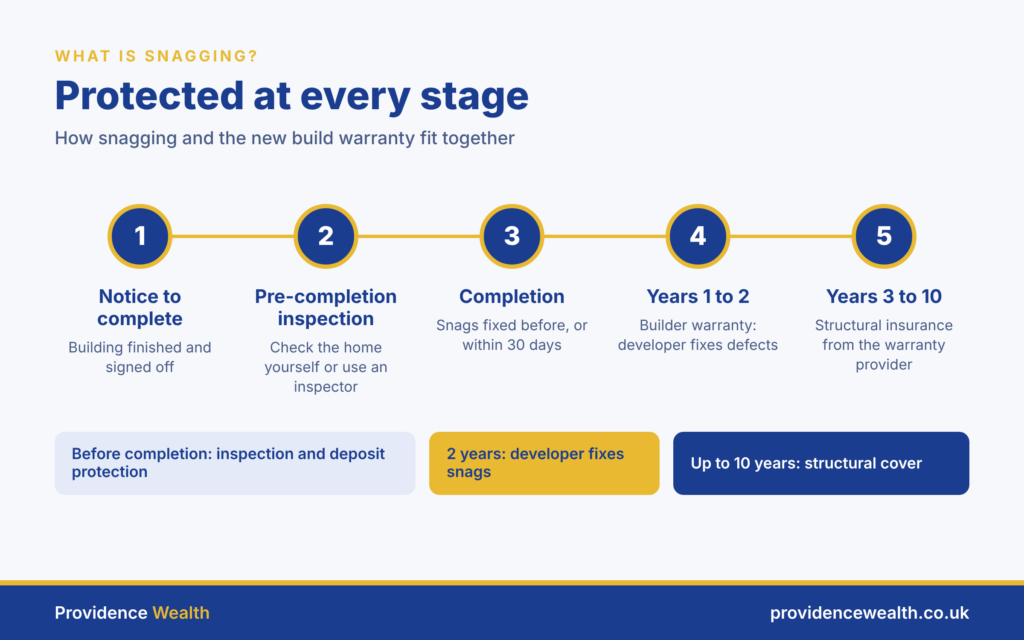
Snagging isn’t a single day. It runs from just before completion through the first two years of ownership, which gives you plenty of time to spot anything that needs attention.
Notice to complete. Once the building is finished and signed off, the developer serves notice to complete. If you’re buying off-plan, your solicitor will guide you through this stage (more on that in our guide to off-plan conveyancing).
Pre-completion inspection. Where the developer is registered with the New Homes Quality Board (NHQB), you’re entitled to the opportunity of a pre-completion inspection after notice to complete and before legal completion. For homes reserved from 2 March 2026, Version 2 of the New Homes Quality Code lets you carry out the inspection yourself or appoint a qualified inspector, using the NHQB’s standard checklist. The exact requirements depend on which version of the Code applies to your reservation.
Completion and handover. Under the Code, issues that breach the warranty’s technical standards should be fixed before completion where possible, or within 30 days if not, with the developer keeping you informed of progress. So your purchase stays on track while the details get sorted.
The first two years. Anything you or your tenant notice after moving in can be reported to the developer’s after-sales team. This is the builder warranty period, and fixing snags and defects is the developer’s responsibility.
Years three to ten. Cover moves to structural insurance from the warranty provider, for the bigger, rarer issues such as foundations, roofs and load-bearing walls.
A practical tip for investors: don’t save everything up. Report snags as they appear, keep photos and emails, and you’ll find the process is usually quick and painless.
Snagging timeline
New build warranty: the safety net behind snagging
Any honest answer to ‘what is snagging?’ has to include the protection behind it. The reason snagging feels reassuring rather than stressful is the protection that comes with a new build. Most new homes in the UK come with a ten-year warranty, and on top of that many developers sign up to an industry code that sets out exactly how snags must be handled.
Protection
What it covers
Who’s responsible
Deposit protection (exchange to completion)
With NHBC Buildmark, cover if the builder becomes insolvent before finishing your home
Warranty provider
Builder warranty period (years 1 and 2)
Defects and snags that don’t meet the warranty provider’s technical standards
Developer, backed by the warranty provider if the developer fails to act
Structural insurance (years 3 to 10)
Insurance against specified defects in key structural parts (such as foundations, roof and external walls) and the damage they cause, subject to the policy terms
Warranty provider
New Homes Quality Code, for NHQB-registered developers (reservation to two years after completion; Version 2 for reservations from 2 March 2026)
Fair sales process, pre-completion inspection, and an after-sales service that should resolve snags within 30 days unless there’s a good reason for delay
Registered developer
New Homes Ombudsman Service
Independent route for unresolved complaints within two years of completion
Ombudsman
The best-known warranty is NHBC Buildmark, and Premier Guarantee and LABC Warranty offer a similar ten-year structure. The New Homes Quality Code adds rules on how developers handle snagging, and if a complaint isn’t resolved, buyers can take it to the New Homes Ombudsman Service.
Two honest notes so you know what to expect. The first two years generally protect you against defects and workmanship that fall below the warranty standards, but not every minor cosmetic imperfection will automatically qualify, so check the specific warranty terms. Cosmetic issues also aren’t covered in years three to ten, so it pays to report anything early. And not every developer is registered with the New Homes Quality Board, so it’s one of the things worth checking before you reserve. It’s exactly the kind of question we ask on your behalf (see our list of questions to ask before buying off-plan).
Put simply, a new build gives you something an older property can’t: a written promise that the developer will fix what isn’t right, with an insurer standing behind them.
New build snagging vs buying a second-hand property
Here’s where the answer to ‘what is snagging?’ becomes a genuine advantage When you buy an existing property, there’s no snagging period and no developer to call. Whatever needs doing on day one, from a tired boiler to a leaking shower tray, is normally your job to arrange and your money to spend.
New build (with snagging and warranty)
Second-hand property
Who fixes early defects?
The developer, during the two-year builder warranty period
You, the owner
Who pays?
The developer
You
Structural protection
Insurance-backed cover, usually up to ten years
Varies. A nearly new home may have some of its original warranty left, and some works may carry their own guarantees, but most older properties have no equivalent cover
Pre-purchase checks
Pre-completion inspection, often against a standard checklist
Survey, then negotiation or repairs at your cost
Complaints route
Developer after-sales team, then the New Homes Ombudsman if the developer is registered
Limited once the sale completes
Tenant experience
Fresh, modern, energy-efficient home, with snags fixed quickly
Depends on the property’s age and condition
Effect on your returns
More predictable early costs
Repairs can eat into early rental income
A simple worked example
Imagine two investors who each buy a one-bed flat to let. In the first year, both properties need a handful of jobs: a door adjustment, resealing a bath, a radiator valve and a kitchen cupboard hinge.
Job in year one
New build investor
Second-hand investor
Sticking door adjusted
Reported to developer, fixed free
Pays a handyman
Bath resealed
Fixed free under warranty
Pays a handyman
Faulty radiator valve
Fixed free under warranty
Pays a plumber
Loose cupboard hinge
Fixed free under warranty
Pays a handyman
Cost to investor
£0
Callout and labour costs, plus time arranging it
The amounts in an older property aren’t usually huge on their own, but they add up, and they land right when you want rental income to start flowing. Lower running costs are one reason new builds can look stronger on a net yield basis. If you’re weighing up an older property that already has tenants, our guide to buying a tenanted property covers what to check.
Enjoy peace of mind and heavier wallet? New build may be your best option.
New build snagging checklist: what to look for
You don’t need to be a builder to do a good snagging check. Take your time, open and close everything, and photograph anything that doesn’t look right. Here’s a room-by-room starting point.
Area
What to check
Front door and entry
Locks turn smoothly, door closes and seals, intercom and door entry work
Walls and ceilings
Even paint, no cracks, marks or patchy areas, clean edges at corners
Doors and windows
Open, close and latch properly, handles secure, no scratches on glass or frames, trickle vents work
Kitchen
Units level and secure, doors aligned, appliances working, sealant neat along worktops and splashbacks
Bathroom
No leaks, good water pressure, drains run freely, sealant complete around bath and shower, tiles and grout neat
Heating and hot water
Heating comes on, radiators or underfloor heating warm evenly, hot water arrives quickly
Electrics
Every socket, switch and light works, extractor fans run, smoke and heat alarms present
Corridors, lifts, bin and bike stores finished and clean
If you’d rather hand the job to a professional, an independent snagging inspector can carry out the pre-completion check for you. For investors buying from a distance, or buying more than one unit, it’s often money well spent. Ask us and we’ll point you in the right direction.
A simple checklist – not based locally? Providence Wealth can manage this on your behalf.
How Providence Wealth supports you through snagging and completion
Knowing the answer to ‘what is snagging?’ takes care of half the job. The other half is having someone in your corner when completion comes round, particularly if you live a long way from the property or you’re juggling a day job. That’s where we come in.
Director-level due diligence. Before a development reaches our website, a director has checked the developer, the build quality, the warranty provider and the track record. Developers who build well tend to snag less and fix faster.
Real numbers on a discovery call. We’ll show you realistic returns for a specific unit, including running costs, so there are no surprises after completion.
A hands-off service. We introduce you to trusted mortgage brokers, solicitors who know new build and off-plan purchases, and letting and management partners who can keep on top of any snags reported by tenants.
Free limited company setup. If you’re investing through a company, we’ll help you get it set up at no cost.
Support through completion. We stay in touch with the developer during the build and help you prepare for the pre-completion inspection, so snags are spotted early and resolved quickly.
Several of our current schemes show this in action. Forum House in St Albans completes in 2026, with share of freehold, no ground rent and a modest service charge. No 5 Guildhall in Norwich is a boutique building of just 28 apartments, and Aire Gardens in Leeds sits beside the new Aire Park on the South Bank. Each comes with a new build warranty and the snagging protection described above.
Ready to talk it through?Book a discovery calland we’ll walk you through a live opportunity, the warranty that comes with it and what completion day really looks like.
Snagging is the process of identifying minor defects, unfinished work or cosmetic flaws in a new build home and having the developer fix them. Typical snags include paint marks, sticking doors and gaps in sealant. Fixing them is the developer’s responsibility during the builder warranty period, usually the first two years.
How long do I have to report snags?
Usually two years from completion. That’s the builder warranty period under NHBC Buildmark and similar warranties, and it matches the after-sales period in the New Homes Quality Code. It’s best to report snags as soon as you spot them rather than waiting.
Is a snagging survey worth it?
For many investors, yes. An independent snagging inspector knows exactly what to look for and produces a clear report for the developer. It’s especially useful if you can’t attend in person or you’re buying more than one property.
Can I refuse to complete because of snags?
Generally, minor snags aren’t a reason to delay completion. Under the New Homes Quality Code, issues found at the pre-completion inspection should be fixed before completion where possible, or within 30 days if not. If you’re worried about something more serious, speak to your solicitor before completion.
What’s the difference between a snag and a defect?
A snag is usually small and cosmetic, such as a scuff or a loose handle. A defect is something that doesn’t meet the required building or warranty standards, which can range from minor to structural. In the first two years, snags and defects that fall below the warranty standards are the developer’s responsibility to put right.
Does snagging affect my rental income?
Rarely. Most snags are small, quick jobs that can be booked around a tenant. A good letting agent will report anything the tenant raises straight to the developer’s after-sales team, so it’s fixed without cost to you.
This article is for general information only and does not constitute legal, financial or investment advice. Warranty terms vary by provider and development, so always check the specific policy and take independent advice before you buy. Property values and rental income can go down as well as up. Information correct as of November 2026.
Market data and statistics referenced across this website are sourced from publicly available reports by ONS, Land Registry, Savills, RICS, and other recognised industry bodies. All figures are provided for indicative purposes only. Property investments carry risk. Capital is at risk and property values can fall as well as rise. Past performance is not a reliable indicator of future results. This website does not constitute financial advice. Independent financial advice should be sought before investing.
Manage Consent
To provide the best experiences, we use technologies like cookies to store and/or access device information. Consenting to these technologies will allow us to process data such as browsing behaviour or unique IDs on this site. Not consenting or withdrawing consent, may adversely affect certain features and functions.
Functional
Always active
The technical storage or access is strictly necessary for the legitimate purpose of enabling the use of a specific service explicitly requested by the subscriber or user, or for the sole purpose of carrying out the transmission of a communication over an electronic communications network.
Preferences
The technical storage or access is necessary for the legitimate purpose of storing preferences that are not requested by the subscriber or user.
Statistics
The technical storage or access that is used exclusively for statistical purposes.The technical storage or access that is used exclusively for anonymous statistical purposes. Without a subpoena, voluntary compliance on the part of your Internet Service Provider, or additional records from a third party, information stored or retrieved for this purpose alone cannot usually be used to identify you.
Marketing
The technical storage or access is required to create user profiles to send advertising, or to track the user on a website or across several websites for similar marketing purposes.
Get our full guide to off-plan investment, real numbers, our due diligence process, and what actually happens from first call to completion. Opens straight in your browser, nothing to download.