Off-Plan Due Diligence: How Providence Wealth Chooses Developments
Choosing the right off-plan investment isn’t about luck. It’s about process.
Off-plan due diligence is the unglamorous part of property investment. It doesn’t make it into the glossy brochure or the CGI, but it’s where good investments are won and expensive mistakes are avoided.
At Providence Wealth, it’s the part of the job we take most seriously. We don’t present every development that lands on our desk. We turn down far more than we take on, and the ones that reach our website have been through the same set of checks, carried out by a director, not a junior or an algorithm.
This guide sets out exactly what those checks are, what we won’t do, and how you can use the same approach to judge any off-plan development, whether you buy through us or not.
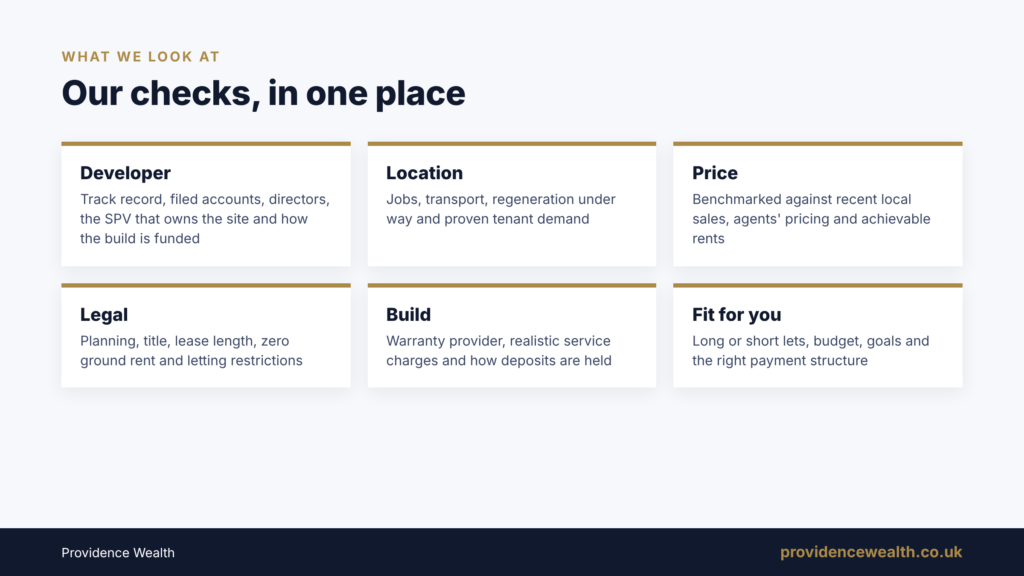
Their track record, finances and company structure are the biggest single factor in whether a development completes well
The location
Jobs, transport, regeneration and tenant demand drive both rent and long-term value
The data
Independent research, not the developer’s brochure, should back up any growth or rent figures
The price
We compare against real local sales and rents, so you’re not paying for the marketing
The legal and build details
Planning, title, lease terms, ground rent, service charges and the warranty provider
The payment structure
Staged, transparent payments that fit how real investors fund a purchase
The fit for you
The right development for one investor can be the wrong one for another
Why off-plan due diligence matters
When you buy off-plan, you’re committing money today to a home that doesn’t exist yet. That’s what makes it attractive (you secure today’s price and pay in stages), and it’s also why the checks before you commit matter so much. Our guide to buying off-plan covers the basics of how the process works.
Most problems in off-plan aren’t bad luck. They’re things that were visible before reservation to anyone who looked: a developer with a patchy history, a price that didn’t match the local market, or a lease with terms nobody read. Good off-plan due diligence is simply the habit of looking.
The seven checks every development goes through
Providence Wealth due diligence process
1. The developer comes first
Before we look at the location, the price or the payment plan, we look at the people building it. A great site in the wrong hands is still a risk.
Track record. What have they delivered before, was it on time, and how was the finished quality and aftercare?
Company structure and finances. We check filed accounts and directors on Companies House, including the special purpose company (SPV) that usually owns the site, and how the build is being funded.
Reputation. We speak to brokers, solicitors and agents who’ve worked with them, and look at what past buyers say.
If the developer doesn’t stand up to scrutiny, the development goes no further, however attractive everything else looks.
2. Location and long-term demand
Location drives both your rent and your long-term value. We look for places with the fundamentals already in place, not just promised:
Strong employment and inward investment
Transport links and infrastructure, existing and funded
Regeneration that’s under way, not just on a masterplan
Proven tenant demand over recent years
That’s why most of our current developments are in cities like Manchester, Leeds and Sheffield, where rents are rising fastest and long-term forecasts are strongest. Our guide to UK rental demand explains the numbers behind that.
3. Independent data, not the brochure
Every developer’s brochure is optimistic. That’s its job. We check the story against independent sources, such as research from Savills, Knight Frank and JLL, ONS rent and price data, and local authority plans. If the brochure says one thing and the data says another, we go with the data.
4. Price against the real market
A competitive price matters, but value matters more. We benchmark every development against recent sales of comparable homes, local agents’ pricing and achievable rents. If the price relies on unrealistic assumptions, we either negotiate or walk away.
Off-plan homes are often sold at a discount to the finished value, but only if the starting price is fair in the first place. That’s the bit we check.
5. The legal and build details
This is the small print that most marketing skips, and where a lot of problems hide.
Planning and title. Is planning in place, and does the developer own the land?
Lease terms. Length of lease, ground rent (it should be zero on new leases) and any restrictions on letting.
Service charges. Are they realistic for the building and its amenities? Our guide to service charges on new build flats explains what to look for.
Warranty. Which provider, such as NHBC, Premier Guarantee or LABC, covers the build? (Our guide to what snagging is explains how that protection works after completion.)
Your deposit. How deposits are held and protected during the build.
We never replace your own solicitor here. We recommend buyers use an independent, SRA-regulated solicitor who acts only for them, and our guide to off-plan conveyancing explains what they’ll check.
6. Rental demand and the likely tenant
Before we put a development forward, we build a picture of who will rent it: young professionals near an employment hub, commuters on a key rail line, or students and staff near a university. We also check whether the development suits long lets, short lets or both, because that affects both your income and your resale options later.
7. A payment structure that works for real investors
We favour developments with clear, fair payment terms: a reasonable reservation fee, a manageable deposit at exchange, and staged payments where they help. It lets you spread your capital without stretching yourself, and it should always be written down clearly before you commit.
Why most developments don’t make the cut
We say “no” far more often than “yes”. It’s not because we’re hard to please. It’s because one weak development can undo years of trust, and we’d rather lose a sale than lose a client.
Two real examples, without naming names:
The guarantee that wasn’t. An investment was marketed with an “uncapped” guarantee. When we read the legal deed, the guarantee was capped, and some of the security documents were missing. We didn’t put it forward.
The resale question. We moved away from a development that was being sold purely as a short-let block, because we were concerned about who would buy those apartments later. We focused on a nearby development with better value, amenities and resale appeal instead.
Neither of those issues was hidden. They just needed someone to look properly.
What we don’t promise
Trust works both ways, so here’s what we won’t tell you:
We don’t guarantee returns. Property values and rents can go down as well as up. Our figures are realistic estimates, and we’ll always show you the assumptions behind them.
We don’t give regulated financial advice. We’ll introduce you to FCA-regulated mortgage brokers and independent solicitors for that.
We don’t rush you. If a development isn’t right for your goals or budget, we’ll say so, even if it means you don’t buy from us.
We don’t claim due diligence removes all risk. It reduces it. Every investment carries some, and you should understand it before you commit.
[Image: off-plan-due-diligence-3-our-promise.png | Alt: What Providence Wealth does and doesn’t promise investors | Caption: Clear on what we do, and honest about what we don’t]
Who we are
Providence Wealth was founded by Sam Taylor and Daniel Baxter, who have more than 20 years of combined experience in UK property. Sam was a founding director at Purplebricks, and Daniel leads our due diligence and developer assessment as Investment Director.
We’re a member of The Property Ombudsman scheme, and our company details are on Companies House (company number 15991169). Our advice and support cost investors nothing: we’re paid by the developer when a sale goes through, and we’re open about that from the first call.
How Providence Wealth supports you
Director-level due diligence. Every development on our website has been through the checks above, carried out by a director.
Real numbers on a discovery call. We’ll show you realistic rents, running costs and returns for a specific apartment, and the assumptions behind them.
A hands-off service. We introduce you to trusted mortgage brokers, independent solicitors who know off-plan purchases, and letting and management partners.
Free limited company setup. If you’re investing through a company, we’ll help you set it up at no cost.
Support through to completion. We stay in touch with the developer during the build and keep you updated, so you’re not left wondering what’s happening.
Want to see the checks in action? Book a discovery call and we’ll walk you through a live development, the due diligence behind it and the numbers for your budget.
Off-plan due diligence is the process of checking a development before you commit money to it: the developer, the location, the price, the legal terms, the warranty and the payment structure. It’s how you reduce the risk of buying a home that hasn’t been built yet.
How do I check an off-plan developer?
Look at what they’ve built before, visit or speak to buyers of past developments if you can, and check their companies on Companies House, including filed accounts and the SPV that owns the site. Ask who is funding the build and which warranty provider covers it.
Is buying off-plan safe?
No property investment is risk-free, but off-plan risk is very manageable with good due diligence, a reputable developer, a recognised build warranty and an independent solicitor acting only for you.
Does Providence Wealth charge investors a fee?
No. Our advice and support cost you nothing. We’re paid by the developer when a sale completes. You’ll only pay partners such as a mortgage broker or management company if you choose to use their services.
Do you guarantee returns?
No. Nobody can honestly guarantee property returns. We show you realistic estimates for a specific apartment and the assumptions behind them, so you can make your own decision.
Why don’t you list more developments?
Because most of the developments we review don’t pass our checks. We’d rather show you a few we’re confident in than a long list we can’t stand behind.
This article is for general information only and does not constitute financial, legal, tax or investment advice. Property values and rental income can go down as well as up, and past performance is not a reliable indicator of future results. Please take independent advice before making any investment decision.
Market data and statistics referenced across this website are sourced from publicly available reports by ONS, Land Registry, Savills, RICS, and other recognised industry bodies. All figures are provided for indicative purposes only. Property investments carry risk. Capital is at risk and property values can fall as well as rise. Past performance is not a reliable indicator of future results. This website does not constitute financial advice. Independent financial advice should be sought before investing.
Manage Consent
To provide the best experiences, we use technologies like cookies to store and/or access device information. Consenting to these technologies will allow us to process data such as browsing behaviour or unique IDs on this site. Not consenting or withdrawing consent, may adversely affect certain features and functions.
Functional
Always active
The technical storage or access is strictly necessary for the legitimate purpose of enabling the use of a specific service explicitly requested by the subscriber or user, or for the sole purpose of carrying out the transmission of a communication over an electronic communications network.
Preferences
The technical storage or access is necessary for the legitimate purpose of storing preferences that are not requested by the subscriber or user.
Statistics
The technical storage or access that is used exclusively for statistical purposes.The technical storage or access that is used exclusively for anonymous statistical purposes. Without a subpoena, voluntary compliance on the part of your Internet Service Provider, or additional records from a third party, information stored or retrieved for this purpose alone cannot usually be used to identify you.
Marketing
The technical storage or access is required to create user profiles to send advertising, or to track the user on a website or across several websites for similar marketing purposes.
Get our full guide to off-plan investment, real numbers, our due diligence process, and what actually happens from first call to completion. Opens straight in your browser, nothing to download.